Positive Best Wishes for Students from Teacher
Published: 5 Aug 2026
Teachers see something special in every student. This page has over 100 unique wishes and messages that teachers can share. Each message is written to help students feel brave, confident, and ready to learn. Whether it’s the first day of school, exam time, or graduation, you will find the perfect words here.
You will also find practical guidance that most wish lists leave out: how to write a note a student will actually keep, what not to say, wishes for the hard situations that come up in every classroom, and a short section on professional boundaries and safeguarding that every teacher writing to students should read.
Best Wishes for Students from Teachers
Here are the best wishes for students from their teacher, filled with encouragement and heartfelt support. These messages remind every student that their teacher believes in their potential and is rooting for their success.

- Learning new things is like opening a gift every day. I am proud of you and your hard work.
- Your effort in class does not go unnoticed. Keep being the great student you are.
- I see how hard you try. That effort will take you far in life.
- You make our class better every single day with your kindness and questions.
- Keep going even when things are hard. You are stronger than you think.
- Your smile and positive attitude make a real difference in class.
- I believe in you and your future is going to be bright.
- Every day you learn something new is a day of success.
- You have grown so much since September, and I hope you can see it too.
- Thank you for the way you help the people sitting near you.
- You ask the questions other people are afraid to ask. That is a real strength.
- Whatever this year brings, you have already shown me what you are capable of.
The wishes in this first group work best as a general note: end of term, a card, a line at the bottom of a returned piece of work. If you want one to land harder, add a single specific detail before you hand it over. “Keep being the great student you are” is warm. “Keep being the great student you are, especially the way you stayed with that fractions unit until it clicked” is something a child reads twice.
Encouraging Words for Students from Teachers
Here are encouraging words from a teacher that speak directly to a student’s heart and fuel their determination to keep going. These messages are perfect for boosting confidence during challenging times at school.

- When you feel stuck, remember that every great learner feels this way sometimes.
- Your mistakes are not failures. They are chances to learn and grow.
- You have talents that no one else has. Keep finding them.
- I am here to help you learn and become your best self.
- Never give up on yourself. I never have.
- You matter more than you know right now.
- Keep asking questions. Questions help us all learn better.
- Your voice and ideas are important in our classroom.
- Not understanding something yet is not the same as not being able to.
- You are allowed to find this hard. Hard is where the learning happens.
- Come and ask me. That is genuinely what I am here for.
- One bad week does not undo everything you have built this year.
Notice how many of these are permission rather than praise. A struggling student usually does not need to be told they are brilliant, because they will not believe you. What they need is permission to find it hard, and a clear signal that asking for help is expected rather than embarrassing. “Come and ask me” does more work than “you can do it” for a child who has already decided they cannot.
Short Positive Messages for Students
Here are short positive messages for students that are easy to share and full of genuine warmth. These quick words of positivity can brighten a student’s day and remind them they are valued.

- You can do hard things.
- Be proud of yourself today.
- You are getting better every day.
- I see your effort and it matters.
- Keep smiling and keep learning.
- You are not alone. I am here.
- Great things take time.
- You are doing just fine.
- Glad you are in this class.
- That was a good question today.
- Progress, not perfect.
- Tomorrow is a clean page.
Short lines are the ones that fit on a sticky note, in the margin of a book, or on a whiteboard at the start of a lesson. They are also the ones a student can repeat to themselves later, which is the whole point. If a message is too long to remember, it stays on the paper. If it is six words, it can travel home with them.
Inspirational Messages for Students
Here are inspirational messages for students that ignite purpose and drive them toward their fullest potential. These messages go beyond simple praise to spark a student’s inner motivation and vision for their future.

- Your dreams are worth chasing. I will help you along the way.
- Remember why you started when things get hard.
- You have a gift to share with the world through your learning.
- Every page you turn in a book is a new world to explore.
- Your curiosity is your superpower in learning.
- The work you do now builds the person you will become.
- You are learning how to be brave right now in this classroom.
- Your future is being built one lesson at a time.
- Nobody else in this room thinks about things quite the way you do.
- You do not have to know what you want to be yet. Keep looking.
- The subject you find hardest may end up being the one you are proudest of.
- Being kind will open more doors for you than being top of the class.
Inspiration is easy to overdo. A message that promises a student they will change the world can feel like one more thing to live up to, especially for a child who is already anxious about performance. The safer form points at who they are becoming rather than what they will achieve, which is something they cannot fail at.
Good Luck Wishes to Students
Here are good luck wishes for students from their teacher that send them into challenges with confidence and positive energy. These wishes show that their teacher’s support goes with them wherever they go.

- Good luck today. Go show what you know.
- I believe in you. Now go and believe in yourself.
- You are ready for this. I know you are.
- Wishing you calm thoughts and clear answers.
- Go out there and shine your light.
- You have what it takes. Let’s go.
- This is your day. Make it great.
- I am cheering for you every step of the way.
- Whatever happens today, you will still be walking back into my classroom tomorrow.
- You have done the work. Today is just the showing.
- Nervous is normal. It means you care about doing well.
- Go steady. There are no prizes for finishing first.
The most useful thing a good luck message can do is take the weight off the outcome. A student who believes their teacher’s approval depends on the result will carry that into the room with them. A student who knows the relationship is safe either way tends to think more clearly. That is why the line about walking back in tomorrow is worth including.
Exam Wishes from a Teacher
Here are heartfelt exam wishes from a teacher that carry genuine support and belief in every student’s ability to do their best when it matters most.

- You studied hard. Now trust what you know.
- Take a deep breath. You have prepared well for this.
- Read each question slowly and carefully.
- Your hard work is about to pay off. Believe it.
- Stay calm and focused. You know this material.
- Write what you know with confidence.
- Every answer you give is a reflection of your learning.
- Remember to check your work when you have time left.
- If one question stops you, move on and come back to it.
- Answer the question in front of you, not the one you revised for.
- Your grade is information about one morning, not a summary of you.
- Eat something and sleep tonight. Both matter more than one more hour of revision.
Exam messages are one of the few places where a teacher can hand over something genuinely practical alongside the encouragement. Two lines of exam technique, such as moving past a stuck question or reading the actual wording rather than the one they hoped for, are worth more on the morning than any amount of general cheerleading. Send both together and you have given them something to do with their nerves. For students who want something to hold onto for strength, a short prayer or a repeated line works the same way.
Funny Exam Wishes for Students
Here are funny exam wishes for students from their teacher that bring a smile and lighten the mood before a big test, because laughter can be the best study partner.
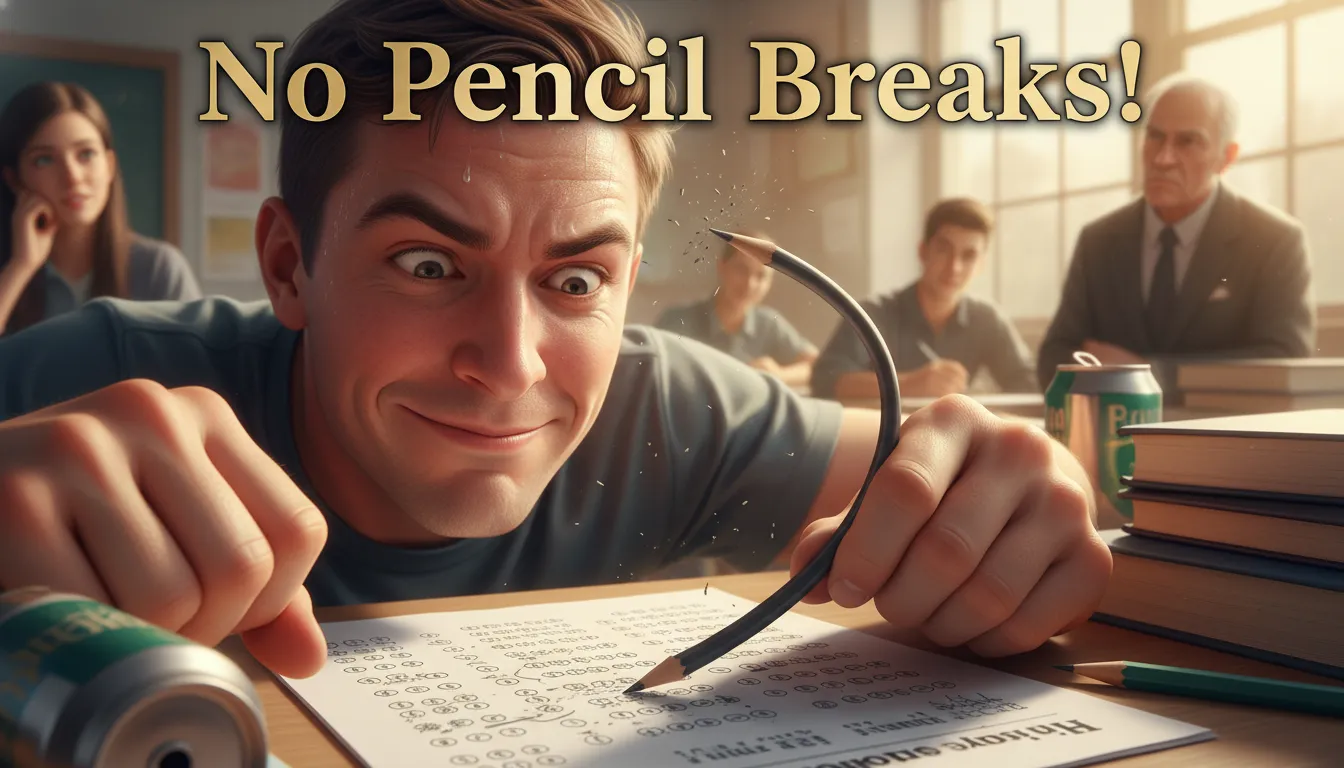
- May your pencil not break and your brain not freeze.
- Remember it is okay to breathe during your test.
- If stuck, just write something. Blank pages score zero.
- I promise the test is not as scary as it looks.
- Your pet probably did not eat your homework this time.
- At least you do not have to share your desk today.
- May your correct answers outnumber your guesses.
- Coffee is not a substitute for sleep, whatever your friends tell you.
- The clock on the wall is slower than you think. Use it.
- Bring two pens. Trust me on this one.
- Your handwriting is about to have the hardest day of its life.
- Whatever happens, I still have to mark it, so spare a thought for me.
Humour before an exam has one rule: it has to be aimed at the situation, never at the student. A joke that could be read as doubting whether they will pass will be read that way by the most anxious child in the room. Keep the target the pencil, the clock, the handwriting or yourself, and the joke does its job of loosening the shoulders.
Inspirational Exam Wishes for Students
Here are inspirational exam wishes for students that go beyond passing a test and remind them of their greater purpose and potential as lifelong learners.

- This test is just one moment in your whole life story.
- Your worth is not written in a test score.
- You are smart in ways tests cannot measure.
- Take courage. You can handle this challenge.
- Let your light shine through your answers.
- This test is a chance to show your growth.
- You are braver than you believe today.
- Remember all you have learned and believe in it.
- Nobody who loves you will love you less this afternoon.
- Exams measure a narrow slice of a person. You are much wider than that.
- Whatever the paper says, you turned up and tried. That counts.
- There is more than one road to where you are going.
That last line is worth saying out loud to older students, because it is true and they rarely believe it. Almost every route people take to a career has an alternative entry point, a resit, a later start or a different qualification. A student who thinks one paper closes every door is more frightened than the situation requires, and telling them the truth is kinder than telling them to relax.
Short and Sweet School Wishes
Here are short and sweet school wishes that pack a world of encouragement into just a few meaningful words, perfect for a quick note that still makes a big impression.

- Have a great day at school.
- I am proud of you.
- Keep being awesome.
- You are enough.
- Stay kind today.
- Learn something new.
- Have fun and be safe.
- I believe in you.
- Good to see you today.
- Try one hard thing.
- Fresh start today.
- Ask if you get stuck.
“Good to see you today” is a small line that carries a lot for a child who has had a difficult morning at home. It asks nothing, promises nothing, and simply says they were noticed arriving. For some students that is the most useful sentence a teacher says all day.
Encouraging Words for School Life
Here are encouraging words for school life that remind students to embrace every part of the journey, including the struggles, as opportunities to grow stronger and wiser.

- School is more than just grades and tests. It is about finding who you are.
- The friends you make in school might be your friends forever.
- Teachers are here because we believe in your future.
- What you learn in school opens doors to amazing places.
- Your teacher sees your potential even if you do not yet.
- Being a good student means trying your best not being perfect.
- School teaches you how to think and solve problems.
- Every year of school makes you smarter and stronger.
- If you have not found your group yet, keep looking. They exist.
- You are allowed to change your mind about who you want to be.
- Nobody is good at everything, and nobody expects you to be.
- Tell someone when school stops feeling okay. That is not complaining.
School life is where the non-academic part of a teacher’s job lives: friendships, belonging, and the long stretches where a child feels invisible. Wishes about school life are worth writing carefully, because they are the ones that speak to the reason most students actually dread or enjoy the building. Sharing encouraging words about friendship alongside them can help a student who is struggling socially more than another line about grades.
First Day of School Wishes
Here are first day of school wishes that set a warm, welcoming tone and help students step through the door feeling excited, safe, and ready to begin something wonderful.

- Welcome to a new school year full of chances to learn.
- Today is day one of something great for you.
- Be brave on this first day. You will do just fine.
- Your new classmates are probably just as nervous as you are.
- Teachers are excited to teach you and get to know you.
- New year, new friends, new chances to shine.
- Remember that everyone is new to this classroom just like you.
- You belong here and you are going to have a good year.
- Nobody expects you to know where anything is yet. Ask anyone.
- Whatever happened last year, this classroom starts from zero.
- If today feels long, that is normal. It gets easier by Friday.
- My door is open at break if you need somewhere quiet.
The two most reassuring things you can tell a student on day one are that nobody expects them to know anything yet, and that last year does not follow them into your room. For a child who arrived with a reputation, the second one can change the whole year. Offering a quiet place at break is also worth saying out loud rather than assuming they know it is allowed.
Good Luck Wishes for School Graduation
Here are good luck wishes for school graduation that celebrate not just the achievement but the entire journey that brought each student to this proud and memorable milestone.

- You did it. You finished and should feel so proud.
- Congratulations on your hard work paying off.
- You grew so much this year. Look how far you have come.
- Your next adventure is about to begin. Get ready.
- You are leaving with knowledge and skills to go far.
- I will miss you but I am excited for your future.
- You are ready for the next chapter of your story.
- Go out and show the world what you can do.
- Thank you for what you brought to this class. It will not be the same.
- You are allowed to feel sad about leaving as well as happy. Both are right.
- Whatever you go on to do, you were a credit to this place.
- Keep in touch, and come back and tell us how it went.
Graduation notes are the ones students keep, so they are worth a minute more than the rest. Name one specific thing they did rather than one general quality they have. “You were always kind” is nice. “You noticed when the new boy was sitting on his own in October and you did something about it” is a sentence they will still have in a drawer at thirty.
Best Wishes for the Future
Here are best wishes for the future that send students forward with hope, purpose, and the confidence to create a life that truly reflects who they are and what they are capable of achieving.

- Your future is bright with endless possibilities.
- Keep learning because the world needs your gifts.
- Where you are going is greater than where you have been.
- Believe in your dreams and make them real.
- The hard work you do today builds your tomorrow.
- You are going to do amazing things in your life.
- Keep that spark of curiosity alive forever.
- Your story is still being written. Make it great.
- You do not need the whole plan. Just the next step.
- It is fine if your path looks nothing like anyone else’s.
- Be someone people are glad to work with. That takes you further than you think.
- Whatever you become, stay someone who asks questions.
Be careful with promises about the future. A wish that guarantees success sets a student up to feel they have let you down if life turns out ordinary or hard for a while. Hopes travel better than predictions, and “I hope you stay curious” is something they can carry without owing you anything.
Blessings for Students
Here are blessings for students that carry a deeper spiritual warmth, wrapping each student in care and asking God to guide and protect them on their educational journey and beyond.

- May you find joy in learning new things.
- May your mind stay open to new ideas.
- May you be kind to yourself when learning is hard.
- May you never lose your love of asking why and how.
- May your efforts bring you success and pride.
- May you make friends who help you grow.
- May you remember these school days with happiness.
- May your future hold everything you deserve.
- May you be given courage on the mornings you do not want to come in.
- May you find one person in this building you can always talk to.
- May you be protected on the journey to school and home again.
- May you grow in wisdom and in kindness, and not only in marks.
If you want to bless a student in words drawn straight from Scripture, the priestly blessing in Numbers 6:24-26 is the oldest and simplest: “The Lord bless you and keep you; the Lord make his face shine on you and be gracious to you; the Lord turn his face toward you and give you peace.” Proverbs 3:5-6 is another good fit for a student choosing a path, and it is honest about not having the whole picture.
One honest note on a verse that gets used constantly at graduations. Jeremiah 29:11, “I know the plans I have for you,” was written to a whole nation in exile who were told to settle down and wait seventy years. It is a real promise, but it is not a guarantee that a particular university or career will work out. Used carefully it offers a student genuine hope. Used as a prediction, it sets them up to feel abandoned when something falls through. Where a school is not a faith school, keep blessings for the students and families who welcome them and stick to secular encouragement otherwise.
Motivation for Students During Tough Times
Here are motivating messages for students during tough times that remind them struggle is a natural part of growth, and that pushing through difficulty is what builds true strength and character.

- Difficult days do not mean you are not capable.
- When you feel like quitting remember why you started.
- Every student has struggled. You are not alone.
- This hard moment will pass and you will be okay.
- Ask for help when you need it. That is brave.
- You have made it through one hundred percent of your hard days so far.
- Slow progress is still progress forward.
- You are doing better than you think you are.
- You do not have to explain everything to me for me to help you.
- Just come in. We can work out the rest once you are here.
- Whatever is happening at home, this classroom is still yours.
- If today is only getting through the day, that is enough for today.
These are the messages to keep closest to hand, and the ones where motivation is often the wrong tool. A student who is grieving, frightened, or living with something difficult at home does not need to be told to push through. They need the pressure lowered and a clear route to help. If a student’s difficulty looks like more than a hard week, read the two sections below before you write anything.
Quotes for Students to Inspire
Here are powerful quotes for students to inspire a mindset of growth, resilience, and purpose as they navigate their academic journey and discover who they are becoming.

- Learning is not a race. It is your own personal journey.
- Your brain can do more than you think right now.
- Mistakes are proof you are trying something new.
- Great things happen when you refuse to give up.
- You are capable of far more than your fears say.
- Kindness and hard work never go out of style.
- Your questions are more important than your answers.
- Keep going. Your story is not finished yet.
- The word you want is not yet, rather than cannot.
- Comparing yourself to the fastest person in the room tells you nothing about you.
- Being confused is what learning feels like from the inside.
- Do the boring bit. That is where most of the progress hides.
A short line becomes useful when a student can hear it in their own head later, which is why the simplest ones survive. “Not yet” rather than “cannot” is small enough to become a habit of speech, and it gives a child a way to describe where they are without describing what they are.
Messages for Different Learning Styles

These are grouped by what a student is drawn to rather than by any fixed type. It is worth saying plainly that the popular idea of matching teaching to a child’s “learning style” has not held up well under research, so treat these as interests to encourage rather than categories to sort children into. A child who loves numbers still needs to read, and a child who loves reading still needs to move.
For Students Who Love Reading
- Books are like windows to new worlds. Keep exploring them.
- Your love of reading will take you anywhere you want to go.
- Keep reading and thinking. The world needs thinkers.
- Try one book this term that you would not normally pick up.
- The way you notice how writers do things is a real skill.
For Students Who Love Math
- Math teaches your brain how to solve any problem.
- Numbers are the language of the universe. You are speaking it well.
- Your brain for math is a special gift. Keep using it.
- Show your working. Your thinking is worth as much as your answer.
- Being wrong quickly and checking is how mathematicians actually work.
For Creative Students
- Your art class work shows your unique way of seeing the world.
- Creativity is not just for art. Use it in everything you learn.
- The world needs people who think in new and different ways.
- Finish something even when you stop liking it halfway. That is the hard part.
- Your ideas are worth writing down before you forget them.
For Active Students
- Your energy and movement help you learn better. That is great.
- Physical activity makes your brain work better for thinking.
- Keep moving and keep learning.
- Needing to move is not the same as not concentrating. Tell me what helps.
- The discipline you bring to training will work just as well on revision.
How to Write a Wish a Student Will Actually Keep
Any of the lines above will do the job. If you want one to stick, these are the things that make the difference.
- Name one specific thing. General praise reads as polite. A detail proves you were paying attention, and that is the part a student cannot dismiss.
- Praise the effort and the choice, not the fixed trait. “You worked at that until it made sense” gives a child something they can repeat. “You are so clever” gives them something to protect, and children who feel clever often stop trying things they might fail at.
- Never compare, even favourably. “The best in the class” tells a student their standing depends on other people staying behind them. Siblings are worse still.
- Do not smuggle criticism into a wish. “I know you could do so much better if you tried” is not encouragement. If feedback is needed, give it separately and clearly.
- Write it by hand where you can. A handwritten line on a returned piece of work is kept. A typed group message is read once.
- Keep it short. Three sentences is plenty. A long message from a teacher can feel like an assessment.
- Do not attach it to a grade. A wish that arrives only with good marks teaches a student that warmth is conditional. Send some on ordinary weeks.
- Make sure everyone gets one eventually. Keep a class list and tick them off. The quiet, compliant students in the middle are the ones who almost never get a note, and they notice.
- Spell the name correctly and use the name they use. This sounds small. It is not.
- Say what you hope rather than what you predict. Hopes cannot be broken. Predictions can.
Wishes for Harder Situations in the Classroom
Most wish lists assume a cheerful classroom. These are for the situations that actually come up and where the standard lines do not fit.
- A student who failed something they worked hard for: This result does not match the effort you put in, and I saw that effort. Come and talk to me about what to do next. Nothing about how I see you has changed.
- A student repeating a year: Starting again is not the same as going backwards. You know this ground better than anyone in the room, and I am glad you are here.
- A student returning after a bereavement: I am so sorry. There is no expectation on you this week. If you need to leave the room at any point, just go, and you do not have to ask.
- A student who has been unwell for a long time: Welcome back. We will catch up the work slowly and in the right order. Your job today is just being here.
- A new arrival who speaks little English: You are welcome here. You can point, draw, or use your own language with me, and we will manage. Nobody expects you to understand everything yet.
- A student leaving mid year: I am sorry you are going and I hope the new school is good to you. You brought something to this class that we will miss.
- A student who has been in trouble: Today is a clean start and I mean that. I would rather have you in this room than not.
- A student with additional needs: You do not have to work the way everyone else works. Tell me what helps and we will build the lesson around that.
- A student whose home is difficult: Whatever is happening outside school, this classroom is a steady place and I am one of the adults here who is on your side.
- A student who is being left out: I have noticed and I am not ignoring it. Come and sit near me at break if you want to, and let us sort this out together.
Boundaries and Safeguarding When You Write to Students
Encouraging a student is part of the job. Doing it safely protects both of you, and it is the part of this topic that almost no wish list mentions. None of this is legal advice, and your school’s own policy always comes first.
- Use official channels only. School email, the school platform, a card handed over in school, or a written comment on work. Not your personal phone number, not private social media, not a private messaging account.
- Write it as though a parent and your head teacher will read it, because one day one of them might. That single test filters out almost everything that could be misread.
- Avoid singling a student out as special to you personally. “You are my favourite” feels kind and creates a problem: it isolates that child, it hurts the others, and it blurs a line that exists for good reasons. Praise what they did instead.
- Keep it about school and about them, not about your own personal life, feelings or difficulties.
- Never promise to keep a secret. If a student tells you they are being hurt, or that they are hurting themselves, you cannot keep that confidential and you should not say you will. Tell them honestly that you have to pass it on to keep them safe, then follow your school’s procedure.
- Know who your designated safeguarding lead is before you need them, and report the same day rather than waiting to be certain. Deciding whether something is serious is their job, not yours.
- Record what you were told in the student’s own words as soon as you can, and pass the record on rather than investigating it yourself.
- Be careful with photographs and names online. Consent for images and for naming students is a school matter, and it varies family by family.
- Meet where you can be seen. If a conversation needs privacy, use a room with a window or an open door and let a colleague know.
- If a student’s family is estranged or their situation is legally complicated, check with the office before sending anything home. A well meant note can land in the wrong household.
When a Student Needs More Than Encouragement
A kind message is not a plan, and there are situations where sending one and moving on is the wrong response. Please read your own school’s policy alongside this.
- Escalate rather than encourage if a student mentions wanting to die, hurting themselves, not wanting to be here, or that nothing matters any more. Take it seriously the first time, stay with them, and get your designated safeguarding lead or a senior colleague now.
- Crisis lines exist for students and for staff. In the US and Canada, 988 can be called or texted at any hour. In the UK and Ireland, Samaritans is 116 123, free, day or night. If someone is in immediate danger, call emergency services.
- Sudden changes are the signal. A student who stops eating at lunch, stops handing work in, withdraws from friends, becomes angry, starts arriving exhausted or stops attending has told you something without saying it. Log it and raise it.
- Do not diagnose. Describe what you have observed in plain language and pass it to the people whose job it is. Naming a condition to a child or a parent is not your role.
- Persistent exam anxiety deserves referral, not a pep talk. A student who is vomiting, unable to sleep, or panicking for weeks before assessments needs pastoral support and possibly medical help.
- Bullying needs recording in writing, not a conversation in a corridor. Ask the student what they want to happen, tell them what you are going to do, and then do it.
- Never tell a struggling student that more faith or more positivity would fix it. Prayer and encouragement sit alongside proper help. They do not replace a doctor, a counsellor or a safeguarding referral.
- Look after yourself too. Carrying a class of difficult situations is heavy, and supervision, a trusted colleague or your employee assistance line exists for you as well.
Autographs for Student Yearbooks

- Keep learning and never stop growing. You are going places.
- Your kindness and hard work have made a difference this year.
- Believe in yourself the way I believe in you.
- You are smart, kind, and going to do great things.
- Thanks for being you. You make school better.
- Keep smiling and keep learning. The world is waiting for you.
- You came in as a student and you are leaving as a thinker.
- Remember this year and remember how strong you are.
- It was a genuine pleasure to teach you. Good luck with everything.
- Stay curious, stay kind, and do not let anyone rush you.
- Wherever you end up, you will be fine. I have seen you work.
- Thank you for this year. Now go and enjoy the next one.
Yearbook messages get read by the whole class, so keep them warm and keep them appropriate for an audience. If you have something more personal to say to one student, write it on a separate card instead. And write the same amount for everyone who asks, because students compare pages.
“Wishing you a bright week of learning and confidence.”
Short, positive lines that mention learning and encouragement work best for students. Add one specific detail about something they did and it will land far harder than the general version.
“You have prepared well. Stay calm and trust your knowledge.”
Give reassurance, remind them of their preparation, and encourage focus. Adding one piece of exam technique, such as moving past a stuck question and coming back to it, is more useful on the morning than more general encouragement.
“Welcome. Be brave, ask questions, and enjoy this new start.”
Warm, welcoming language that says they belong reduces first day nerves. Two things worth adding out loud: nobody expects them to know where anything is yet, and whatever happened last year does not follow them into your room.
“Keep learning and believing in yourself. Your future is bright.”
Short, memorable, and forward looking messages are best for yearbooks. Remember that the whole class reads them, so keep anything more personal for a separate card, and write a similar amount for everyone who asks.
“Small steps matter. I am proud of your effort and I am here to help.”
Focus on effort, offer support, and validate progress to build confidence. A struggling student often needs permission to find it hard and a clear route to help more than they need to be told they are capable, because they will not believe that yet.
Praise the effort, the strategy and the choice rather than a fixed trait. “You stayed with that until it made sense” gives a student something they can repeat next time. “You are so clever” gives them a label to protect, and children who feel clever sometimes avoid anything they might fail at. Many teachers now deliberately favour effort based praise for this reason.
Use official channels only: school email, the school platform, a card handed over in school, or a comment written on their work. Not a personal phone number and not private social media. A good test is to write every message as though a parent and your head teacher will read it, and your school’s own policy always takes precedence.
Separate the result from the effort and from your view of them: “This result does not match the effort you put in, and I saw that effort. Come and talk to me about what happens next. Nothing about how I see you has changed.” Then actually make time for that conversation, because the offer is the part that matters.
In a faith school, or with a student and family who would welcome it, yes. Elsewhere it is better to keep messages secular and save blessings for those who have invited them. Never suggest that more faith or more positivity would fix a student’s difficulty, and never let a blessing take the place of a referral to proper help.
Listen, thank them for telling you, and do not promise to keep it secret. Say honestly that you have to pass it on to keep them safe. Write down what they said in their own words as soon as you can, then report it to your designated safeguarding lead the same day rather than waiting until you are certain it is serious. Deciding that is their job, not yours.
Conclusion
These wishes and messages come straight from a teacher’s heart. Every word is meant to help students know they are seen, valued, and believed in. Words have power. Use these wishes to lift students up and help them believe in their own power to learn and grow.
If you take only one thing from this page, take the habit of naming something specific. A student can argue with “you are brilliant.” They cannot argue with “I saw you stay with that problem when everyone else had given up.” That is the note they keep, and it costs you fifteen seconds.
Keep a class list beside you and work through it, so that the quiet students in the middle get a message too. Send some in ordinary weeks and not only after good results. And where a student’s difficulty is bigger than a hard week, pass it on to the people whose job it is, because a kind note and a safeguarding referral are not alternatives to each other. A teacher who does both is doing the work properly.






- Be Respectful
- Stay Relevant
- Stay Positive
- True Feedback
- Encourage Discussion
- Avoid Spamming
- No Fake News
- Don't Copy-Paste
- No Personal Attacks
- Be Respectful
- Stay Relevant
- Stay Positive
- True Feedback
- Encourage Discussion
- Avoid Spamming
- No Fake News
- Don't Copy-Paste
- No Personal Attacks
